A control architecture is the arrangement that decides, on a repeating basis, what an output should do. Four arrangements dominate industrial work: relay logic, the programmable logic controller, the programmable automation controller, and the distributed control system. They overlap in function and diverge in assumption. Each one encodes a belief about the plant around it: how often the process changes, how long it runs between stops, how many points it touches, and which organization owns the software after commissioning.
This PLC vs DCS vs PAC comparison classifies all four architectures, relay logic included, before comparing them. It does not rank them, because ranking requires a single criterion and no single criterion exists here. Relay logic is old, but it has not become an obsolete predecessor to the programmable controller. It remains the correct answer for a defined set of jobs. A programmable automation controller is not a faster programmable logic controller; it is a controller built with a different set of assumptions. A distributed control system is not a large programmable logic controller; it is a category of purchase made by a different buyer and supported by a different engineering group. The productive question is not which architecture is best. The productive question is which architecture matches the job in front of you.
Before the comparison, the terms need definitions, because the industry uses all four loosely.
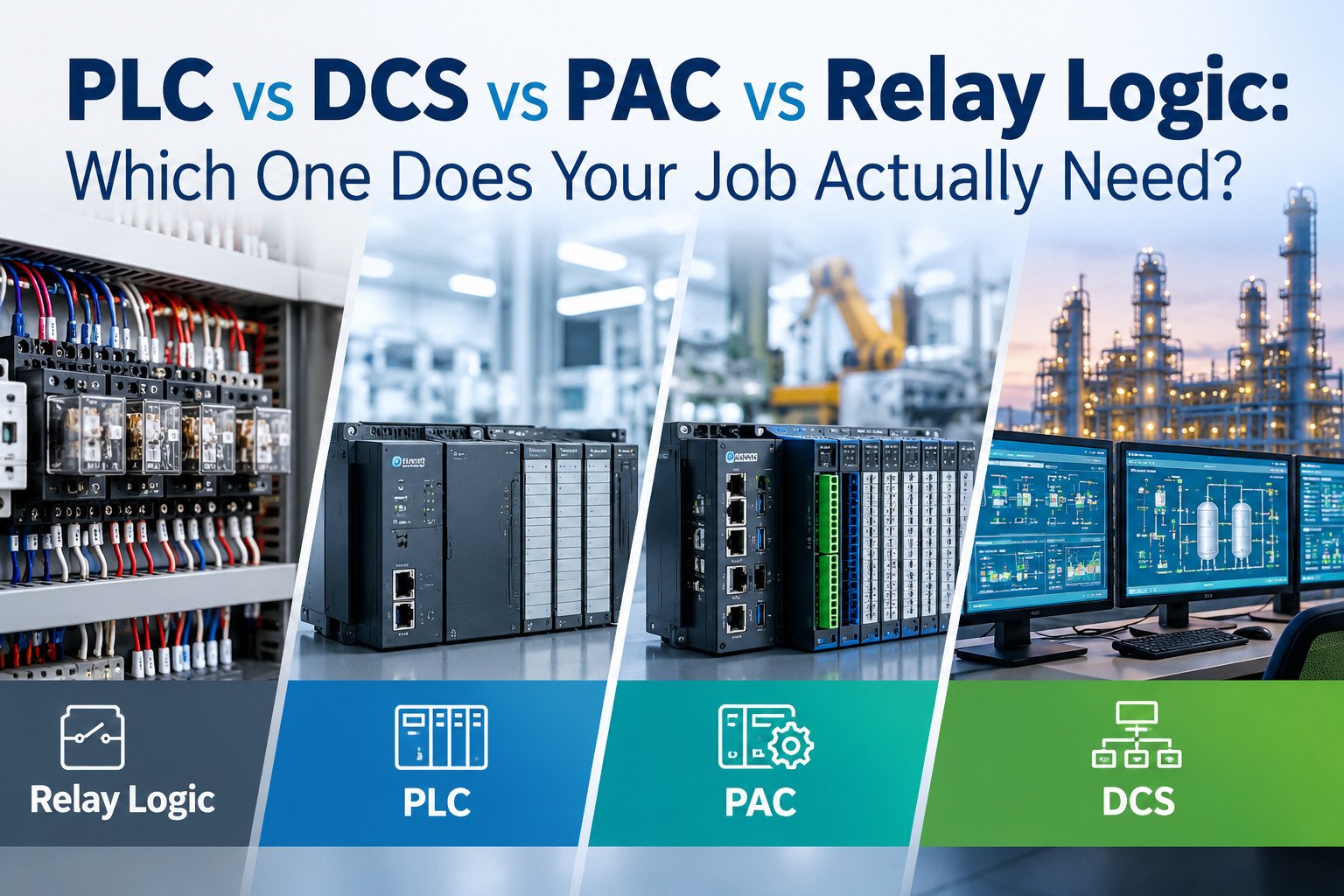
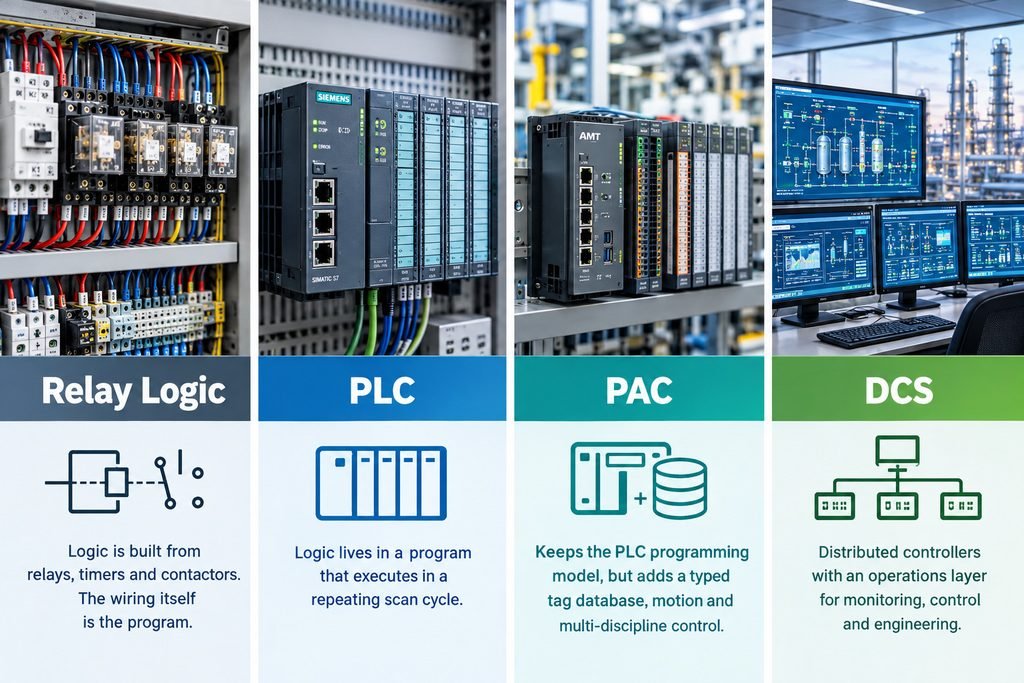
A relay is an electromechanical switch driven by a coil. Relay logic is control built from relays, timers, and contactors wired to one another, so that the wiring itself is the program. A PLC is a controller built for discrete, repeating machine logic. A PAC is a controller that keeps the PLC programming model but adds the data handling, motion, and multi-discipline capacity of a small process system. A DCS is a control architecture built for a continuous process that runs for months without a stop. The difference among them is not speed. It is what the architecture assumes about the plant around it.
Table 1: What each controller class is built for
| Architecture | Primary purpose | Typical process | Change frequency | Where logic lives |
|---|---|---|---|---|
| Relay logic | Fixed, hardwired interlocking | One machine, one function | Rarely | In the wiring |
| PLC | Discrete, repeating machine logic | Machine or cell control | Occasionally | In a program running a scan cycle |
| PAC | Multi-discipline machine and line control | Line control, motion, data handling | Frequently | In a program plus a tag database |
| DCS | Continuous process regulation | Plant-wide continuous flow | Occasionally, but plant-wide | In distributed controllers plus an operations layer |
Where the control decision lives
The clearest way to separate the four architectures is to ask where the decision actually sits. In relay logic, the decision lives in copper. A contact is either open or closed, and the path of current through the panel is the logic. Nothing interprets anything; the physical state of the hardware is the answer. This is the reason relay panels can be read with a meter and a wiring diagram, and the reason a change to the logic is a change to the hardware.
In a PLC, the decision lives in a program that executes as a repeating scan. The controller reads its inputs into an image, solves the logic, and writes the outputs, then starts again. The decision is not in the wiring but in the firmware’s interpretation of the ladder, function block, or structured text the programmer wrote. The wiring only carries signals to and from the processor.
In a PAC, the decision still lives in a program, but the program is organized around a named, typed tag database rather than around physical addresses alone. A value is a named variable with a data type, and the application can move that value between control, motion, and data functions without leaving the controller.
In a DCS, the decision is distributed. Several controllers each own a slice of the process, and the operational and engineering functions live in a separate layer above them. The operator station, the historian, and the engineering configuration tools are part of the architecture, not accessories attached to it. The decision is spread across the field controllers, but the way a human configures and observes it is centralized.
Table 2: Where the control decision lives
| Architecture | Location of logic | Basis of a change | Effect of a change |
|---|---|---|---|
| Relay logic | Copper paths and contact state | Rewire, add, or remove devices | Physical panel work and downtime |
| PLC | Program executed each scan | Edit the program and download | Logic change without rewiring |
| PAC | Program plus a typed tag database | Edit the program and database | Logic, motion, and data change together |
| DCS | Distributed controllers plus an operations layer | Reconfigure points and control modules | Plant-wide change through the engineering tool |
Rule of thumb: Relay logic suits fixed interlocking under a defined device count. A PLC suits machine logic that changes occasionally. A PAC suits a job that needs motion or data alongside logic. A DCS suits a process the plant owns end to end.
Relay logic, and what a hardwired panel still does better
Relay logic is the oldest of the four and the most misunderstood in its current role. It is not a stepping stone that every project should climb past. It is a technology with genuine advantages that a processor cannot duplicate, and those advantages explain why hardwired panels are still built today for the right jobs.
A hardwired interlock path is deterministic in a way that is easy to state and hard to fake. Current flows or it does not. There is no scan time, no firmware revision, and no program that can be paused or corrupted. When a safety function must open a contactor coil the instant an interlock breaks, a hardwired chain of contacts does that without depending on a processor being healthy. This is why safety functions are often kept in a hardwired or certified safety-rated path even when the rest of the machine runs on a standard controller.
A hardwired panel is also readable without a laptop. A maintenance technician can trace a wire, measure a coil, and see the state of a contact. The state is visible. In a controller, the same decision is buried in a program that requires the right software, the right project file, and the right access level to inspect.
Hardwired panels scale down gracefully. For a single pump with a level switch and a float, a handful of relays and a contactor is smaller, cheaper, and simpler than a controller, a power supply, and a program. The components are widely available, their behavior is stable across decades, and a technician who has never opened a programming suite can service the panel.
The limitation is proportional to complexity. Every new function adds devices and wires. A hardwired panel that controls ten interlocks is manageable; the same approach for a hundred interlocks becomes a cabinet full of copper that is slow to change and slow to fault-find.
Relay logic also keeps no record of what happened. There is no event history, no data logging, no remote diagnostics, and no way to report status to a supervisory system without adding devices. It scales in cost and size in direct proportion to the number of functions, which is exactly the behavior a processor avoids.
The contactors, overload relays, timing relays, and switching components that form the logic and output stage of a relay panel are still current catalog products, not spare parts for a museum. A well-built hardwired interlock panel is a legitimate design choice, and an engineer who calls it legacy has usually not had to prove a safety trip response time in front of an auditor.
The PLC as it is actually used on a machine today
A PLC is a ruggedized industrial computer that executes a stored program in a controlled cycle. The cycle repeats continuously, and the phases are always the same:
1. read the inputs into the input image
2. solve the user program against that image
3. write the output image to the output modules
4. service communications and internal housekeeping
5. start the next scan
The length of one pass through that loop is the scan time, and for discrete machine logic it is short enough that the machine behaves as if the response were immediate.
On a machine today, the PLC is rarely alone. It usually sits at the center of a small cluster: a power supply on the backplane, a set of digital and analog I/O modules wired to the machine, a human machine interface for the operator, perhaps a drive on a network, and possibly a remote I/O drop at the far end of the machine to shorten cable runs. The controller coordinates these parts and holds the sequence logic that defines the machine’s behavior.
The programming model is the reason PLCs dominate machine control. Ladder logic, function block diagram, structured text, and sequential function chart all describe cause and effect in a form a machine builder can maintain. A machine builder delivers one machine, keeps a copy of the program, and returns to service it. The project is owned by the builder, not by the plant’s process engineering group. The scale is a machine: tens to a few hundreds of I/O points, one or a few controllers, one or a few operator panels.
A current-generation PLC also typically offers integrated features that once required separate devices: high-speed counter inputs, pulse outputs for simple motion, PID loops for a temperature or pressure loop, and in many ranges an integrated safety function. The line between a PLC and a smaller PAC has blurred at the low end, which is why the practical test is not the product label but the job the controller is expected to do. For the fundamentals of what the controller does and how its scan behaves, the PLC basics explained from the shop floor is the companion piece.
The PLC’s defining assumption is that the thing it controls stops. Machines are stopped for changeovers, maintenance, and shifts. A PLC is designed for a process that can be halted, reloaded, and restarted, and its engineering is organized around one machine and one owner.
What a PAC adds over a PLC
The term PAC, programmable automation controller, names a controller that keeps the PLC programming model and adds capabilities a plain PLC historically lacked. The distinction is not a single feature but a bundle of assumptions. Where a PLC is built around physical addresses and a machine, a PAC is built around a tagged, typed namespace and a broader set of tasks.
Field note: The acronym itself came from marketing. ARC Advisory Group coined “programmable automation controller” in 2001 to name the class of controllers that had outgrown the PLC label: multi-domain control, one development environment, shared tag database. The hardware existed before the word did, which is why the boundary with a modern high-end PLC is still argued about.
The first addition is a tag-based programming model. In a PAC, variables have names and data types, and the application is written against those names rather than against raw input and output addresses. This makes large programs readable and makes it practical to reuse code across machines.
The second addition is capacity. PACs generally carry more memory, faster processors, and support for user-defined data types and structures. This matters when the application is no longer a simple sequence but a data-processing task: logging production, calculating statistics, managing recipes, or exchanging structured records with a higher-level system.
The third addition is multi-discipline integration. A PAC commonly integrates motion control, high-speed analog, and in many ranges communication to drives and to enterprise systems within one chassis and one programming environment. Where a PLC might need a separate motion controller, the PAC can host motion as a native function.
The fourth addition is openness. PACs typically speak several industrial protocols at once: an industrial Ethernet protocol for I/O, a fieldbus for drives and devices, and standard Ethernet or a messaging protocol for data exchange. This makes the PAC a natural hub at the boundary between the machine and the plant network.
The practical consequence is that a PAC is a machine and line controller built for a job that has grown beyond discrete logic. It still belongs to the machine builder, but it carries responsibilities that touch data and motion as well as sequencing. The control and monitoring products around it, the HMIs and the distributed I/O, are chosen to match that broader role rather than to fill gaps the controller could not close.
DCS, as something a plant buys rather than a machine builder
A distributed control system is defined less by its processors than by its ownership. A DCS is purchased by a plant, deployed across a process, and supported by the plant’s own engineering and operations organization for a decade or more. It is an architecture, not a controller, and the architecture includes the operator stations, the engineering stations, the network, the historian, and the configuration database as first-class parts.
The design assumption of a DCS is a continuous process that runs for months without a stop. Refining, chemical production, power generation, and large continuous manufacturing fit this assumption. In that setting, the priority is not a fast scan on a single machine but stable regulation across thousands of points, redundant networks and controllers so that no single failure stops the process, and an operator interface that presents the whole plant as a coherent picture.
A DCS distributes control. Each controller owns a defined section of the process, and the sections are coordinated over a redundant network. Configuration happens through a central engineering tool that defines control modules, points, and displays. The operator works from displays that were configured from that same database, so the control and the visualization stay consistent.
The entry cost and the engineering discipline are both high. A DCS project involves system integration, configuration, and commissioning on a scale a single machine builder never sees. The payoff is lifecycle stability: a plant expects the system to be supported, expanded, and kept secure for many years, with vendor programs for migration between generations.
This is why a DCS is rarely the right answer for a machine builder. A machine builder delivers a machine, not a plant; the machine has boundaries, a finite point count, and an owner who will service it. A DCS has none of those simplifying properties. It assumes the plant is the unit of design.
The four architectures side by side
The table below compares the four on the criteria that decide most projects. It is a summary, not a rule. The section after it turns the summary into worked choices.
Table 3: The four architectures compared
| Criterion | Relay logic | PLC | PAC | DCS |
|---|---|---|---|---|
| Scale of the job | One function to a small panel | One machine or cell | A line or several cells | A plant-wide continuous process |
| Basis of logic | Hardwired contacts | Program plus I/O addresses | Program plus typed tag database | Distributed control modules |
| Change method | Rewire the panel | Edit and download | Edit program and database | Reconfigure through engineering tool |
| Motion and data | None without extra devices | Limited, often separate | Integrated | Integrated at plant scale |
| Redundancy | Not applicable | Optional on some ranges | Optional on high-end ranges | Standard expectation |
| Ownership | The panel builder | The machine builder | The machine or line builder | The plant engineering group |
| Lifecycle assumption | Years, rebuilt when needed | Machine lifetime | Line lifetime | Decade or more with vendor migration |
| Skill needed to change it | Wiring technician | Controls programmer | Controls programmer with data skills | Process and system engineers |
Warning: Do not move a safety function into a general-purpose controller program unless that controller has a certified safety subsystem rated for the function and the risk assessment supports it. A standard PLC output executing an interlock rung is not a safety function merely because the rung is written carefully. A hardwired path or a certified safety relay is not a legacy choice; it is a design decision.
Matching the choice to the job
Choosing an architecture is a matter of matching its assumptions to the job, and the match is decided by four questions. How many points does the job touch? How often will the logic change? Does the job include motion or data handling alongside logic? And who will own and service the system after it is running?
Ask those four in order and most jobs resolve quickly.
Worked case 1: a single packaging machine. The machine has a control panel, a set of sensors, a few drives, and an operator panel. The point count is in the tens. The sequence logic changes when the product changes, a handful of times a year. There is no plant-wide data requirement. The owner is the OEM that built the machine. This is a PLC job. A PAC would work but would be underused. A DCS is not a candidate. Relay logic would be possible only if the logic were fixed and simple, which a packaging sequence rarely is.
Worked case 2: an extrusion line with coordinated motion. The line has several drive axes that must be synchronized, a temperature profile that must be regulated across zones, and a requirement to log production data and pass it to a plant system. The point count runs into the hundreds. The logic changes as the product mix changes. The owner is the line builder, but the plant expects data. This is a PAC job. Its native motion, its analog handling, and its data capacity match the requirement. A plain PLC would force separate devices for motion and data, and a DCS would be heavier than the job warrants.
Worked case 3: a continuous process running around the clock. The process has thousands of I/O points, runs for months between stops, and requires redundancy so that a controller or network failure does not stop production. The operator interface must present the whole process, and a historian must record it. The owner is the plant. This is a DCS job. A PAC can control parts of it, and often does, but the plant-scale redundancy, the centralized operations layer, and the multi-year support model are what define the DCS and are what the job needs.
Worked case 4: a fixed interlock on a utility pump set. Two pumps, a level switch, a pressure switch, and a contactor with a hardwired interlock between them. The logic will not change. The job is to start, stop, and protect. Relay logic is the correct answer. A controller adds cost, a program to maintain, and a power supply for capability the job will never use. This case is included deliberately: relay logic is not always the wrong answer.
Table 4: Matching the job to the architecture
| Job profile | Point count and scope | Change cadence | Motion or data | Recommended |
|---|---|---|---|---|
| Fixed utility interlock | Small, single function | Rare | Neither | Relay logic |
| Machine or cell | Tens to low hundreds | Occasional | Limited | PLC |
| Line with motion and data | Hundreds | Frequent | Both | PAC |
| Continuous plant process | Thousands | Occasional, plant-wide | Both, at scale | DCS |
Quick answer: If one builder delivers one machine and the logic rarely changes, you need a PLC or, for fixed interlocking, relay logic. A DCS becomes relevant only when the plant, not the machine, owns the process.
The four most common ways projects pick wrong
Wrong picks are rarely random. They follow four recurring patterns, and each one has a signature that can be recognized before the order is placed.
- Sizing to the sales conversation rather than the process. A project buys a high-end PAC because it was presented as more capable, then uses a fraction of its capacity and pays for the rest in cost and complexity. The fix is to answer the four matching questions before the vendor call, so the specification leads the conversation rather than following it.
- Reaching for a DCS on a machine-scoped job. A machine builder, or a plant buying one machine, selects a DCS because the term sounds more robust. The result is a system whose operations layer, redundancy, and support model are larger than the job and whose configuration effort is disproportionate. The fix is to recognize that a machine has boundaries and an owner, and that a DCS assumes neither.
- Replacing a hardwired safety or interlock path with software that is not rated for it. The motivation is usually tidiness or cost. The result is a safety function that now depends on a processor being healthy and a program being correct. The fix is to keep the function in a hardwired or certified safety-rated path where the risk assessment calls for it.
- Designing to the point count alone. Point count is one input among four. A project that picks a controller purely by I/O count will miss the motion requirement, the data requirement, or the ownership model, and will discover the gap at commissioning. The fix is to weigh all four matching questions, not the easiest one to count.
What to confirm before you order anything
The specification should be settled before a part number is chosen. The following checklist covers what to confirm in writing, and it applies to all four architectures, because even a relay panel has a scope to freeze.
- ☐ Total I/O count, split by digital input, digital output, analog input, and analog output, with a growth margin stated.
- ☐ The special functions the job needs: high-speed counting, pulse or coordinated motion, PID loops, or none.
- ☐ The required determinism, stated as a response time the process must meet, not as a scan time copied from a datasheet.
- ☐ The safety functions, their risk assessment, their required performance level, and whether each belongs in hardwired logic, a certified safety controller, or neither.
- ☐ The change cadence, meaning how often the logic is expected to change and who is expected to change it.
- ☐ The ownership and support model: who holds the project file, who services the system, and for how many years.
- ☐ The network topology and the protocols the controller must speak to drives, I/O, and higher-level systems.
- ☐ The environment: ambient temperature, enclosure rating, vibration, and electrical noise.
- ☐ The spare parts and expansion plan, including which modules will be held in stock.
- ☐ The exact ratings, current capacities, and terminal arrangements taken from the manufacturer’s own datasheet, not from a summary.
Every rating, current capacity, terminal arrangement, and I/O count should be read from the manufacturer’s current datasheet for the specific part number in front of you. Catalog numbers, firmware compatibility, and list prices change by range and region, and no summary table substitutes for the datasheet of the exact product being ordered.
The choice, in one paragraph
A control architecture is chosen by matching assumptions to a job. Relay logic is chosen when the logic is fixed and the path must be visible. A PLC is chosen when a machine repeats a discrete sequence. A PAC is chosen when the job carries motion and data alongside logic. A DCS is chosen when a plant owns a continuous process and needs the architecture that assumption implies. Get the assumption right and the rest of the project follows; get it wrong and no amount of capacity will fix it.
About TZ Tech
TZ Tech supplies industrial automation, electrical, instrumentation and telecommunications components, including rare and discontinued parts other suppliers can’t source. We buy ready-to-ship distributor stock, so prices stay competitive and lead times stay short.
You get the part you ordered, at the price and lead time we quoted. Legacy and discontinued items come with an honest, accurate report on their real condition, so there are no surprises when the box arrives.
Send your inquiry and you hear back within 6 hours. In-stock items ship without delay.
Every component is screened and inspected before it leaves us. Brand-new parts carry a full 1-year warranty.
If a part isn’t right, we make it right, and we stay reachable after the sale.
Have a project or a part you need? Send us the details and we’ll get back to you fast.
Contact us →