*Industry news | Sinamics E210 launch | November 2, 2026*
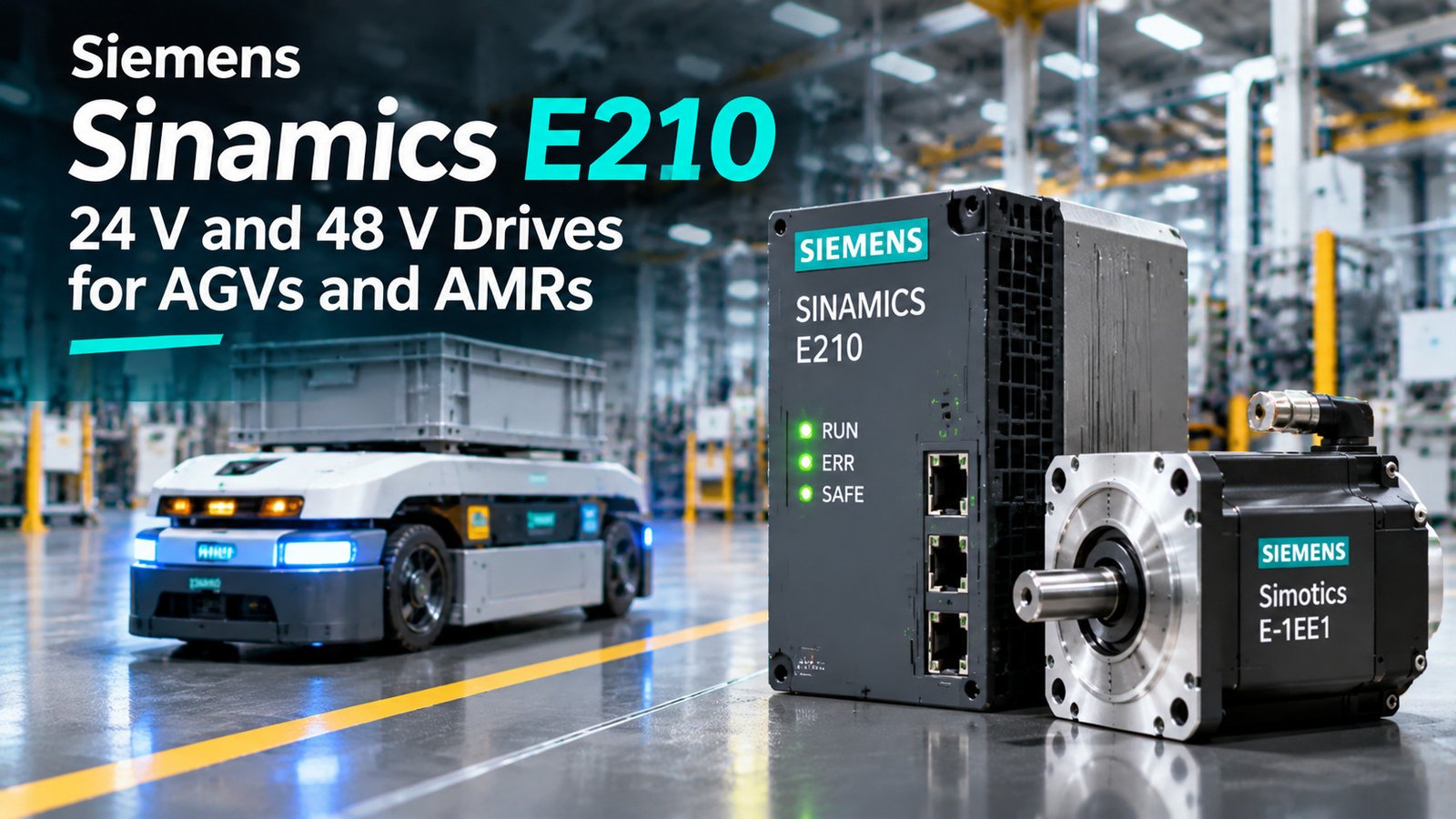
Siemens announced the Sinamics E210 converter and the Simotics E-1EE1 servomotors on November 2, 2026. Both products target battery-powered automated guided vehicles, autonomous mobile robots and driverless transport systems. The Sinamics E210 is a compact regenerative converter for 24 V and 48 V battery systems, and it drives traction, wheel, steering, lifting and auxiliary axes.
This is a product launch with no price, order codes or delivery date published.
Table 1: What Siemens published on November 2, 2026, and what it withheld
| Item | Status in the release |
|---|---|
| Sinamics E210 | Announced: compact, regenerative, 24 V and 48 V |
| Simotics E-1EE1 | Announced: shaft heights 40 to 63 |
| Motor safety scope | Dual-channel design, up to SIL 2 |
| Price | Not published |
| Order codes (MLFB) | Not published |
| Availability or delivery date | Not published |
| Efficiency, payback, volume | Not published |
| End of a current product line | Not stated, do not assume |
Quick answer: Siemens launched a low-voltage drive pair for mobile machines on November 2, 2026. The converter runs straight from a 24 V or 48 V battery, carries integrated safety functions and works inside TIA Portal. Price, order codes and delivery timing were not released.
What Siemens announced and what it did not publish
The release covers two new products. Siemens added the Sinamics E210 to its extra-low-voltage drive portfolio and paired it with the Simotics E-1EE1 servomotors, both aimed at battery-powered mobile systems.
Siemens states four goals for the pair:
- Less integration effort for mobile systems.
- Simpler implementation of safety concepts.
- A foundation for future requirements.
- Investment security through a scalable architecture.
Treat those as vendor claims, not measured results. No independent test data accompanied the release.
Still, much of what a buyer needs is missing. Siemens published no price, no order code, no availability window and no delivery date. The release also stayed silent on efficiency, payback, sales volume and on whether any current line ends.
One note on the brand: Siemens announced the next generation of the Sinamics G drive platform on October 28, 2026. That is a separate announcement, and the two releases do not reference each other.
Sinamics E210 in engineering terms
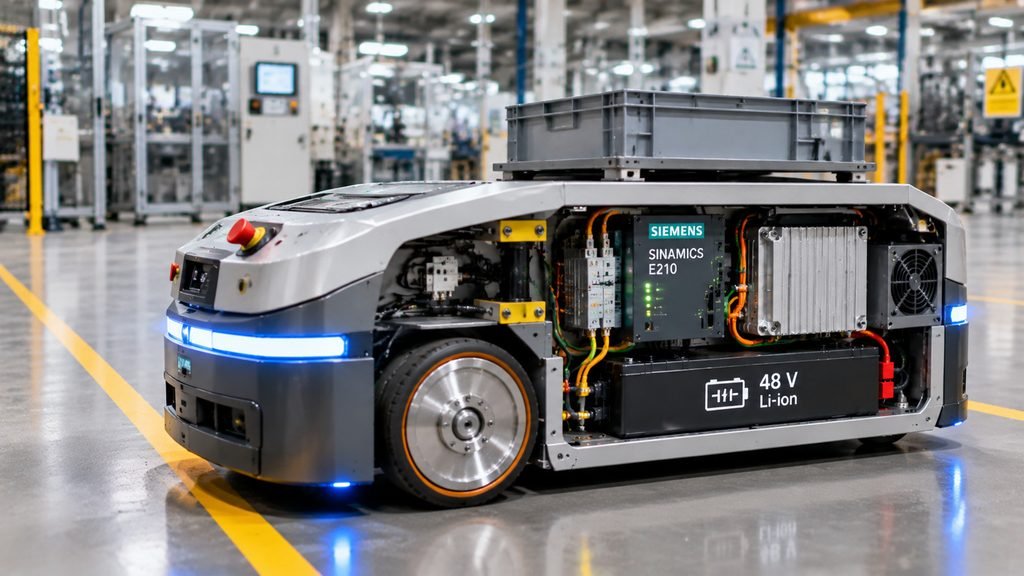
The Sinamics E210 is a compact regenerative converter for 24 V and 48 V applications. Because it connects directly to an ELV battery system, it removes the extra voltage conversion stage many mobile platforms carry.
In practice, axis scope runs wider than traction. Siemens lists traction and wheel drives plus steering, lifting and auxiliary axes on the same device.
Communication and safety also sit inside the converter. It carries integrated safety functions with PROFIsafe support and PROFINET IRT for motion traffic. Integration into TIA Portal and Simove, Siemens’ modular system for mobile machines, comes with it.
Two terms deserve a plain definition, because both shape the wiring and the risk assessment. A regenerative converter can feed braking energy back toward the battery instead of burning it in a resistor. PROFIsafe is the functional-safety profile that runs over PROFINET, so safety signals travel alongside standard data.
Field note: A regenerative front end changes the electrical design of the whole vehicle, not just the drive. Agree with the battery supplier early on how much charge current the pack and its BMS will accept during braking.
Simotics E-1EE1 motors: shaft heights, encoder, safety
Siemens paired the converter with a new motor family. The Simotics E-1EE1 comes in shaft heights 40 to 63 and is built for 24 V and 48 V systems.
Feedback comes from an absolute 14-bit BiSS-C safety encoder. Siemens describes an internal dual-channel design that supports safety-related applications up to SIL 2.
Warning: Read the safety ceiling carefully. The publication says SIL 2 and makes no SIL 3 claim for this motor. If your risk assessment lands on SIL 3, this family does not close the loop alone.
Electronic nameplates remove a manual step, since the Sinamics E210 reads the stored motor data automatically instead of asking an engineer to type parameters from a label. Options cover holding brakes, gearbox variants and flexible connection technology.
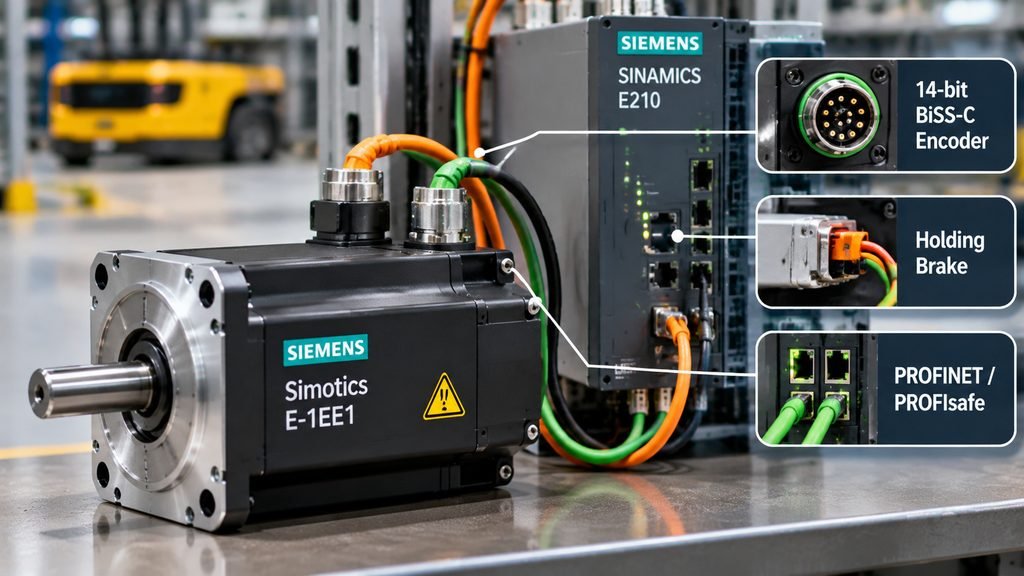
Table 2: Sinamics E210 and Simotics E-1EE1 at a glance
| Feature | Sinamics E210 | Simotics E-1EE1 |
|---|---|---|
| Role | Converter, all mobile axes | Servomotor for 24 V and 48 V |
| Voltage | 24 V and 48 V | 24 V and 48 V |
| Safety | Integrated functions, PROFIsafe | Dual-channel, up to SIL 2 |
| Feedback | Not described at converter level | Absolute 14-bit BiSS-C encoder |
| Network | PROFINET IRT | Not stated |
| Engineering | TIA Portal and Simove | Nameplate read by the E210 |
Why extra-low voltage matters on an AGV or AMR
Extra-low voltage, or ELV, conventionally means 60 V DC and below. Battery-powered AGVs and AMRs run in that band. That forces the drive to work from pack voltage rather than a converted rail.
Because the drive works straight from the battery, a conversion stage disappears. Each stage removed takes its losses, heatsink volume, cabinet space and failure modes with it. On a vehicle that must fit under a conveyor, that space counts as much as the energy.
Regenerative operation also suits the duty cycle. An AGV brakes at every stop and drop-off point, so a converter that returns that energy to the pack recovers part of it.
Safety still needs a clear eye. ELV lowers shock risk during service, yet a moving vehicle also needs a validated stop function, monitored speed and a safe way to remove torque. The SIL 2 motor rating covers part of that chain, not all of it.
Rule of thumb: Size an ELV traction drive on the worst braking event in the route, not on the average. A pack that accepts charge slowly will fault on a downhill run with a full load.
What a machine builder should check before designing this in
Ordering the pair is the easy step, but these checks decide whether the design holds up in the field. Siemens published no compatibility matrix with the launch.
- ☐ Battery window: nominal voltage, cut-off limits and the regen current the BMS accepts.
- ☐ Safety chain: functions your risk assessment requires, and whether SIL 2 is enough.
- ☐ Axis count: traction, steering, lifting and auxiliary axes mapped to converters.
- ☐ Controller: TIA Portal project version and PROFINET IRT support.
- ☐ Mechanics: holding brake, gearbox ratio and connection technology per axis.
- ☐ Space and cooling: mounting envelope in the frame plus cable routing.
- ☐ Spares: what maintenance needs on the shelf for year one.
Table 3: Confirm before you commit to an E210 design
| Question | Why it matters | Where to confirm |
|---|---|---|
| What charge current will the pack accept? | Braking energy needs somewhere to go | Battery and BMS datasheet |
| Which safety functions are in scope? | The SIL 2 motor rating is one link | Machine risk assessment |
| Which TIA Portal version supports it? | The project will not compile otherwise | Siemens device documentation |
| How many axes per vehicle? | Sets converter count and cabinet volume | Your vehicle layout |
| Is this a retrofit or a new build? | No migration statement was published | Siemens application support |
How the Sinamics E210 fits the wider drive portfolio
Siemens sells Sinamics drives across several voltage classes and motion tasks, so the E210 sits at the low end of that range. There, a machine runs from a battery rather than a cabinet supply.
Integration matters most to teams that already run Siemens. Because the converter works inside TIA Portal and Simove, they keep one project, one safety configuration method and one spare-parts philosophy.
However, the honest position for a plant manager weighing a retrofit is that Siemens published a launch, not a migration path. No statement covers replacing an ELV drive on a vehicle already in service. A retrofit therefore needs its own evaluation of mechanical fit, wiring, safety validation and spares.
The Sinamics E210 and Simotics E-1EE1 give mobile-machine builders a Siemens option at 24 V and 48 V. Integrated safety and native TIA Portal integration come with it, but several of the questions above still need data Siemens has not published. Still, treat the launch as the start of an evaluation, not the end of a selection.
About TZ Tech
TZ Tech supplies industrial automation, electrical, instrumentation and telecommunications components, including rare and discontinued parts other suppliers can’t source. We buy ready-to-ship distributor stock, so prices stay competitive and lead times stay short.
You get the part you ordered, at the price and lead time we quoted. Legacy and discontinued items come with an honest, accurate report on their real condition, so there are no surprises when the box arrives.
Send your inquiry and you hear back within 6 hours. In-stock items ship without delay.
Every component is screened and inspected before it leaves us. Brand-new parts carry a full 1-year warranty.
If a part isn’t right, we make it right, and we stay reachable after the sale.
Have a project or a part you need? Send us the details and we’ll get back to you fast.
Contact us →